Heart-shaped recliner
Kay ScarpettaThe heart-backed chair is the bathroom chair at the center of the forensic reconstruction of Terri Bridges’s murder. Its gold-colored metal frame, heart-shaped back, and black satin seat make it visually distinctive, but its decisive significance is structural rather than decorative: the chair preserves the geometry of the crime. Marks on its seat, Terri’s injuries, the fragments embedded in her knees and feet, and the killer’s necessary reach all converge on the conclusion that she was restrained there and strangled from behind. The chair therefore changes the investigation from a question of suspicion into a measurable question of bodies, height, force, and position.
Appearance and Setting
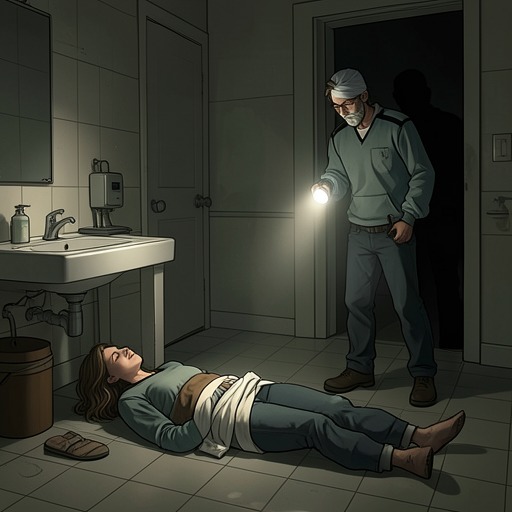
The chair appears in photographs of Terri’s bathroom beside the white marble vanity. The room otherwise looks carefully ordered: perfume bottles, a brush, and a comb stand arranged on the marble surface, while an oval mirror hangs crookedly above it. In front of the vanity is the small gold-colored metal chair with its heart-shaped back and black satin seat. The juxtaposition is important. The chair belongs to an intimate domestic arrangement, yet its placement in the bathroom makes it the fixed point around which violence was organized.
The surrounding furniture is made from connected surfaces. The sink counter, cupboards, and vanity with its drawer are formed from one piece of marble, while the rear of the vanity against the tiled wall is painted white plywood. Scarpetta’s examination of splinters found in Terri’s knees and the tops of both feet showed that they came from unpainted plywood. The chair thus cannot be read in isolation: its position before the vanity explains how Terri’s struggling legs came into contact with the furniture beneath and beside it.
Forensic Reconstruction
Scarpetta concludes that the killer had already tied Terri’s wrists behind her back before removing her robe and bra. When she was forced onto the chair, the seat placed her directly before the mirror. Scarpetta’s theory is that the killer made Terri look at herself while strangling her, converting the mirror and chair into instruments of enforced self-observation. As Terri fought, her legs struck the sharp edge of the vanity. The resulting linear abrasions and deep bruising in her thighs correspond to that struggle, while the violent impact of her knees against the unpainted underside of the vanity was sufficient to fracture her kneecaps and drive plywood splinters into her skin.
The chair’s seat also retained dark marks and stains. Scarpetta identifies them as probably involving lubricant, with the possibility that tissue and blood from Terri’s injured legs were present as well. The lubricant mattered because it suggested that Terri had been seated on the chair during the sexualized assault and strangulation, a possibility investigators had initially overlooked. Scarpetta therefore treated the chair not merely as furniture photographed at the scene but as a surface capable of preserving the physical sequence of the attack.
The investigation tested the reconstruction directly. Scarpetta moved the chair to the middle of the bathroom floor, measured its metal leg to the black-covered seat, and used rope cut to the lengths of Terri’s and Oscar Bane’s bodies, legs, and reach. She fixed the strands to the wall above the chair so that the proposed positions could be compared visually and mathematically. The method makes the chair an experimental apparatus: its height supplies a constant against which the participants’ bodies can be measured.
The Chair and the Case Against Oscar Bane
The chair’s dimensions are central to Scarpetta’s argument that Oscar Bane was unlikely to have killed Terri in the manner shown by the evidence. Terri’s body measured eighty-four and a quarter centimeters in the relevant reconstruction, while Oscar’s arms extended only about sixteen inches from shoulder to fingertips. Because Terri was nearly as tall as Oscar, he would have had little mechanical advantage if he had stood behind her and repeatedly pulled upward and backward against her resistance. Scarpetta contrasts this with Benton Wesley’s substantially longer reach: Benton would have stood almost twenty inches above Terri in the same position and could have exerted far greater upward force.
This is not a claim that Oscar’s strength was nonexistent or that the physical act was absolutely impossible. Scarpetta presents it as a probability judgment grounded in leverage, height, reach, and the repeated nature of the strangulation. The chair turns the question into one of biomechanics. It shows why a suspect’s apparent fit with the crime cannot be separated from the architecture of the room and the proportions of the people in it.
The reconstruction also supports the inference that Terri was seated while the killer strangled her from behind. In the recorded killing, gloved hands pull her backward with a blue tourniquet while she kicks violently against the chair. The chair scrapes across the tiles when the killer forces her down onto it. These movements correspond with the physical traces previously identified: the seat, the vanity’s lower surface, the bruising of the thighs, and the plywood fragments in the knees and feet. The object links the visible violence in the recording to the material evidence recovered from the body and bathroom.
Recorded Violence and Narrative Significance
The chair’s heart-shaped back creates one of the investigation’s most disturbing contrasts. It is a soft-edged, almost sentimental form placed in a room of perfume, clothing, and personal grooming, yet it becomes the platform for a prolonged sexualized killing. Terri is made to face her reflection, her wrists remain bound behind her, and the killer lowers her only when she loses consciousness before beginning again. The chair’s apparent gentleness therefore intensifies rather than mitigates the scene’s brutality: an emblem of comfort is made to support domination, exposure, and repeated loss of control.
The object also concentrates the novel’s larger movement from uncertainty to recognition. Early theories account for delayed reporting through shame, concealment, or grief, and the investigators must distinguish between what a scene seems to show and what its physical details prove. The chair supplies that discipline. Its position, marks, and measurable relation to Terri’s body expose weaknesses in the preliminary narrative and help redirect attention away from Oscar. In this sense, the chair is both crime-scene object and narrative device: it converts a frightening image into a testable arrangement of surfaces, distances, wounds, and force.
Its recurring presence finally reveals how an ordinary object can become unbearable once its use is known. Before the reconstruction, the chair is simply one element among the bathroom furnishings. Afterward, every feature carries the memory of the assault: the heart-shaped back, the black satin seat, the scraping legs, and the distance between the seat and the vanity. The chair’s material stability outlasts the competing stories told about Terri, Oscar, and the killer, making it a quiet but powerful witness to what happened.